Sliding vs. Swing Doors in Clean Rooms: The Definitive 4-Factor Guide for Optimal Choice
Sliding vs. Swing Doors in Clean Rooms: The Definitive 4-Factor Guide for Optimal Choice
In environments where air purity and particle control are non-negotiable – from ISO-certified pharmaceutical labs to life-saving Hospital Operation Theatre Door settings – the choice of entryway is paramount. Selecting between Clean Room Sliding Doors and Clean Room Hinged Doors (Swing Doors) impacts contamination risk, workflow, safety, and compliance. This detailed 4-factor comparison equips you with the knowledge to make the optimal, performance-driven choice for your critical environment.
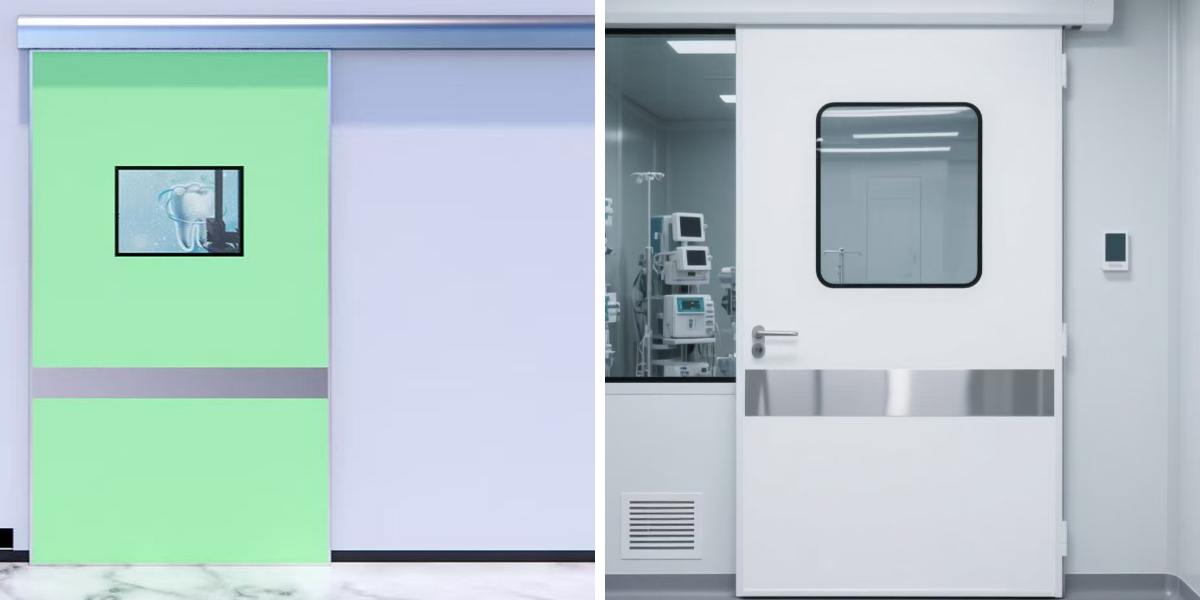
1. Contamination Control & Airflow Integrity: The Foundation of Cleanliness
The Imperative: Maintaining unidirectional laminar airflow, minimizing turbulence, and preventing ingress of contaminants is the core function of any clean room or operating theatre barrier.
Clean Room Sliding Doors:
Superior Sealing: Operate parallel to the wall, utilizing advanced compression gaskets (often triple-sealed) that engage fully upon closure against the frame, creating a near-hermetic barrier.
Minimal Air Disruption: Movement occurs within the doorway plane, causing significantly less disturbance to established laminar airflow patterns compared to swinging motions. Turbulence generation is drastically reduced.
Eliminates "Piston Effect": Avoids forcibly sweeping large volumes of air from adjacent, potentially less clean areas (like corridors) into the critical zone upon opening – a critical advantage for Hospital Operation Theatre Door entries where pathogen ingress is unacceptable.
Clean Room Hinged Doors:
Inherent Turbulence Generator: The swinging arc acts like a paddle, forcibly displacing air from one side to the other. This disrupts laminar flow, stirs settled particles, and risks cross-contamination between zones.
Seal Integrity Challenges: Achieving and maintaining consistent, high-pressure compression around the entire perimeter during the swing (especially hinge and latch sides) is mechanically more difficult than with sliding doors. Potential for micro-gaps exists.
"Piston Effect" Vulnerability: Opening a swing door, especially into a higher-pressure clean room or theatre, actively pulls corridor air inside. This poses a severe contamination risk incompatible with stringent ISO classes or sterile surgical fields.
Verdict: Clean Room Sliding Doors offer inherently superior and more reliable contamination control and airflow stability, making them essential for high-classification areas and sensitive applications like operating theatres.
2. Space Optimization & Workflow Efficiency: Maximizing Value and Movement
The Challenge: Clean room real estate is premium, and operating theatres demand seamless patient and staff flow. Door operation must not hinder movement or waste space.
Clean Room Sliding Doors:
Zero Swing Clearance Needed: Operate within the wall cavity or overhead track. Absolutely no valuable floor space inside or outside the doorway is sacrificed for door swing clearance. This is invaluable in tight corridors, equipment-packed labs, or near sterile instrument tables in theatres.
Full, Immediate Access: Provide 100% of the clear opening width from the moment movement starts. Personnel, large equipment, carts, and gurneys pass through effortlessly without navigating around a swinging panel.
Optimized Traffic Flow: Ideal for high-traffic areas or two-way movement points. Users flow smoothly without coordination to avoid door swings, crucial for efficient Hospital Operation Theatre Door transitions during procedures.
Clean Room Hinged Doors:
Significant Space Sacrifice: Require a substantial arc of clear floor space (typically 90-180 degrees) on the opening side(s). This space cannot be utilized for equipment, storage, or workflow, severely limiting layout flexibility near entrances.
Partial Access & Maneuvering: The opening path is obstructed until the door is fully open. Moving bulky items requires careful navigation to avoid collisions with the door or walls, slowing down operations.
Traffic Coordination Required: Simultaneous entry/exit necessitates awareness to avoid collisions with the moving door panel, potentially causing delays or accidents.
Verdict: Clean Room Sliding Doors are the undisputed champion for maximizing usable space and enabling rapid, unobstructed personnel and equipment movement, directly enhancing operational efficiency in constrained or busy environments.
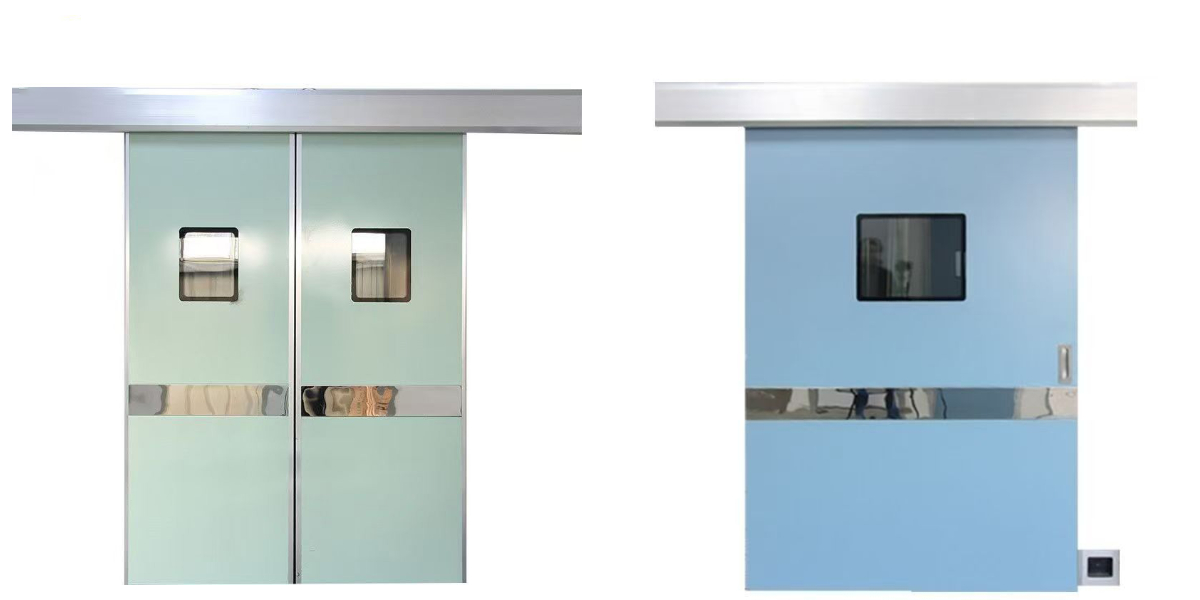
3. Ease of Cleaning, Maintenance & Long-Term Integrity
The Imperative: Doors must withstand rigorous, frequent cleaning protocols without degrading, and require minimal maintenance to ensure ongoing performance and safety.
Clean Room Sliding Doors:
Smooth, Cleanable Surfaces: Typically feature large, flat, uninterrupted panels (especially frameless designs) with minimal seams, crevices, or protruding hardware. This allows for fast, effective wiping and disinfection w